
Evaluation of blood irradiation indicators for dose verification and FDA recommendation compliance
Justin Czerniawski PhD, Vice President – R&D and Peter Daniel
Blood irradiation protects patients from transfusion-associated graft-versus-host disease (TA-GVHD), a rare but serious condition where donor immune cells attack the recipient’s body. Irradiation indicators are the small labels placed on blood products to show that irradiation happened. We wanted to know how well today’s indicators show the dose a product actually received, so we put three of them to the test.
Background and Objective
Irradiation of cellular blood components is performed to prevent transfusion-associated graft-versus-host disease (TA-GVHD). FDA recommendations specify a minimum dose of 15 Gy and target dose of 25 Gy for all irradiated blood products intended for transfusion.1,2 Gy (gray) is the unit used to measure absorbed radiation dose. While irradiation indicators are routinely used as part of quality assurance programs, many are designed only to indicate exposure and not to verify a specific delivered dose.3,4 The objective of this study was to compare the response of three commercially available blood irradiation indicators across clinically relevant dose levels and assess their ability to visually differentiate delivered dose.
Materials and Methods
AccuTagTM (15 Gy), Rad-SureTM (15 Gy), and RAD-CONTROL (15 Gy) blood irradiation indicators were irradiated using a calibrated RS® 3400 X-ray blood irradiator at doses of 10, 15, 25, 50, and 75 Gy and unirradiated control (0 Gy). For each dose level, a single unirradiated indicator of each type was placed at evenly spaced locations within the central region of a blood phantom (a stand-in that mimics a blood product). Immediately following irradiation, indicators were visually evaluated by primary researchers under fluorescent light for dose-dependent visual response and their ability to differentiate between irradiation dose levels.
Results
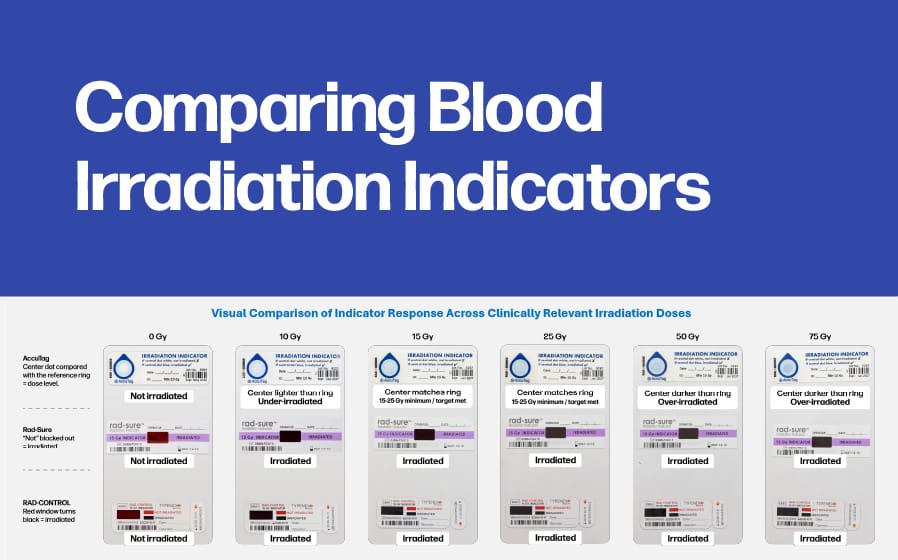
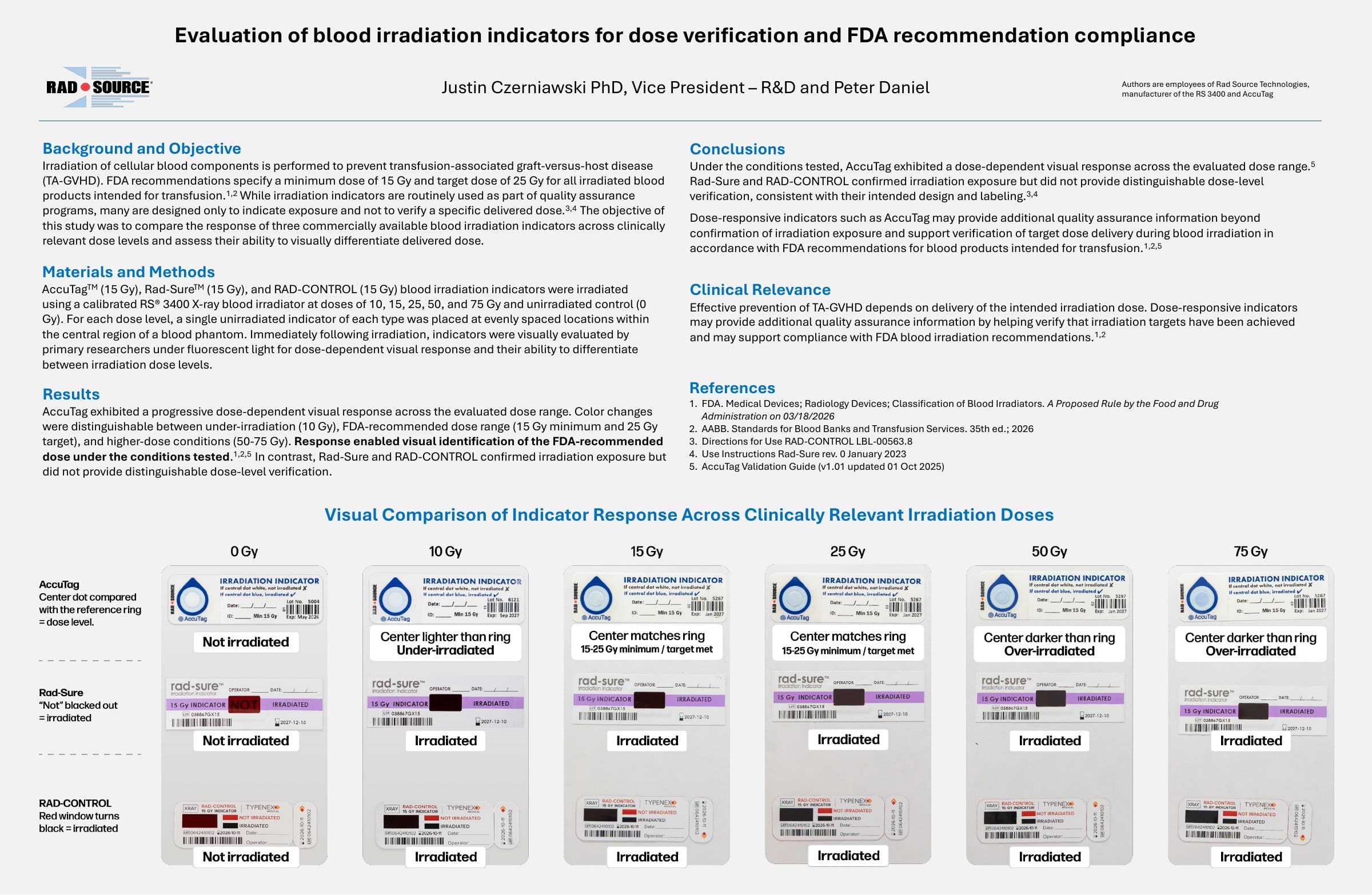
AccuTag exhibited a progressive dose-dependent visual response across the evaluated dose range. Color changes were distinguishable between under-irradiation (10 Gy), FDA-recommended dose range (15 Gy minimum and 25 Gy target), and higher-dose conditions (50-75 Gy). Response enabled visual identification of the FDA-recommended dose under the conditions tested.1,2,5 In contrast, Rad-Sure and RAD-CONTROL confirmed irradiation exposure but did not provide distinguishable dose-level verification.
Visual Comparison of Indicator Response Across Clinically Relevant Irradiation Doses
AccuTag
Center dot compared with the reference ring = dose level.
- 0 Gy: Not irradiated
- 10 Gy: Center lighter than ring. Under-irradiated
- 15 Gy: Center matches ring. 15-25 Gy minimum / target met
- 25 Gy: Center matches ring. 15-25 Gy minimum / target met
- 50 Gy: Center darker than ring. Over-irradiated
- 75 Gy: Center darker than ring. Over-irradiated
Rad-Sure
“Not” blacked out = irradiated.
- 0 Gy: Not irradiated
- 10, 15, 25, 50 and 75 Gy: Irradiated
RAD-CONTROL
Red window turns black = irradiated.
- 0 Gy: Not irradiated
- 10, 15, 25, 50 and 75 Gy: Irradiated
See all three indicators side by side at every dose in the full research poster. Click to view the full PDF here.
Conclusions
Under the conditions tested, AccuTag exhibited a dose-dependent visual response across the evaluated dose range.5 Rad-Sure and RAD-CONTROL confirmed irradiation exposure but did not provide distinguishable dose-level verification, consistent with their intended design and labeling.3,4
Dose-responsive indicators such as AccuTag may provide additional quality assurance information beyond confirmation of irradiation exposure and support verification of target dose delivery during blood irradiation in accordance with FDA recommendations for blood products intended for transfusion.1,2,5
Clinical Relevance
Effective prevention of TA-GVHD depends on delivery of the intended irradiation dose. Dose-responsive indicators may provide additional quality assurance information by helping verify that irradiation targets have been achieved and may support compliance with FDA blood irradiation recommendations.1,2
Have questions about the study or about dose verification in your lab? Reach out to our team. We’re always happy to talk.
Submit an inquiry here.
Authors are employees of Rad Source Technologies, manufacturer of the RS 3400 and AccuTag
References
- FDA. Medical Devices; Radiology Devices; Classification of Blood Irradiators. A Proposed Rule by the Food and Drug Administration on 03/18/2026
- AABB. Standards for Blood Banks and Transfusion Services. 35th ed.; 2026
- Directions for Use RAD-CONTROL LBL-00563.8
- Use Instructions Rad-Sure rev. 0 January 2023
- AccuTag Validation Guide (v1.01 updated 01 Oct 2025)